The woodcutter kills the informer and helps his wife and daughter escape
The Most Precious of CargoesThe woodcutter kills the informer and helps his wife and daughter escape in a sudden confrontation that turns the Poor Woodcutter’s home into a place of sacrifice: he attacks the man who has exposed the child, gives his family time to flee, and faces the armed men himself.
The Informer’s Visit and the Seizure Attempt
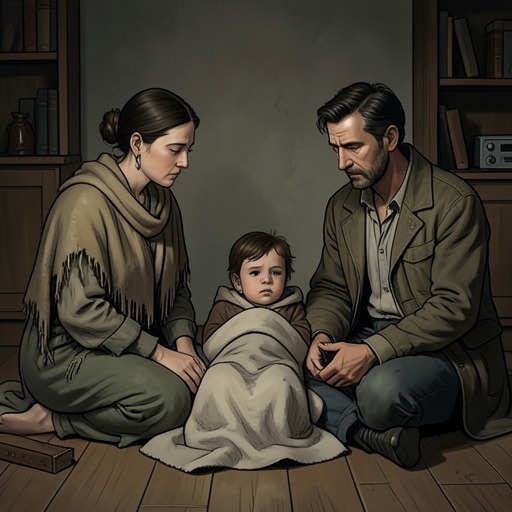
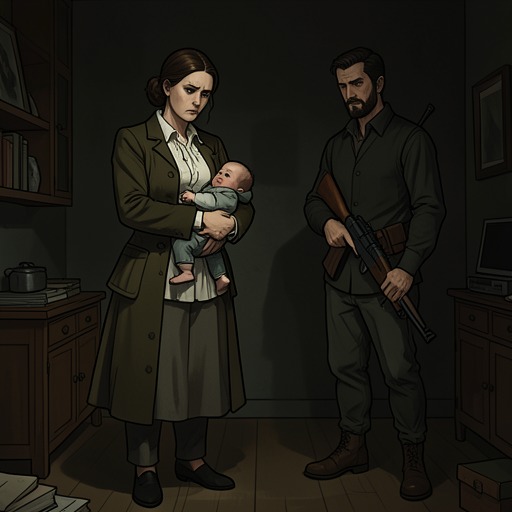
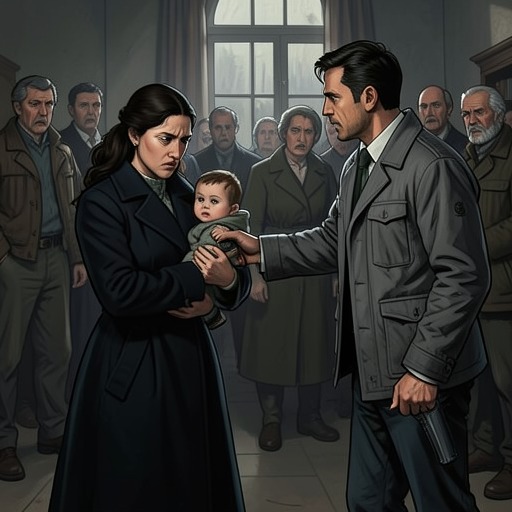
The danger first takes the form of an ordinary encounter. As the Poor Woodcutter’s Wife and Little cargo return through the undergrowth after gathering firewood, they meet the Wood-Alcohol Distiller, the Poor Woodcutter’s incidental colleague and comrade. He politely asks where the child came from. She answers that the child is hers. The distiller studies Little cargo, then looks at the Poor Woodcutter’s Wife, smiles, and departs with a courteous greeting. His politeness makes the encounter seem harmless, but his later return with armed men reveals its consequence: he has identified the child to the authorities. Shortly before dawn, the Wood-Alcohol Distiller comes to the cabin with two militiamen carrying rifles. The Poor Woodcutter meets them at the threshold and first denies their accusation, claiming Little cargo is his daughter. When asked why he did not register her birth at the town hall, he says that he dislikes filling in documents and that the child has simply grown up undocumented. The militiamen press him with the threat of death, and he eventually confesses. He then asks to hand the child over to his comrade, ostensibly so the seizure can be carried out gently and the rifles will not frighten Little cargo or his wife. By bringing the Wood-Alcohol Distiller inside and calling for his wife to prepare the child and fetch the visitors a drink, he creates the opportunity to act.
The Attack and the Escape
When the Poor Woodcutter’s Wife appears holding Little cargo, the child immediately reaches out to the Poor Woodcutter. He seizes his ax and brings it down again and again on the Wood-Alcohol Distiller’s head, then turns on the militiamen. The comrade he had invited inside as though to make the seizure gentler is the first target; the Poor Woodcutter’s sudden violence breaks the calm arrangement of the dawn visit and gives his wife the chance to flee with the child.
Outside the cabin, the Poor Woodcutter fells one militiaman. The other backs away, stumbles, fires a shot into the air, and then aims at him as he advances with the ax raised. The Poor Woodcutter crumples. His wife runs out as he falls, and he calls for her to escape and save herself, praying that their child will live. His farewell makes the purpose of the attack unmistakable: he cannot secure safety for his family by negotiation, but he can spend his remaining moments trying to keep the child beyond the reach of the armed men.
The escape leaves the Poor Woodcutter’s Wife and Little cargo to run from the cabin and the husband who built it from logs. The narrator urges them not to look back at him lying in his own blood or at the cabin where the three had shared a brief happiness. The rescue is therefore also a rupture: the Poor Woodcutter’s defiance protects his wife and daughter by separating them from him, turning the home that had sheltered their new family into the scene from which they must flee.
The Rescue’s Afterlife
The Poor Woodcutter’s attack does not end the danger or free him from the violence around his family. The later account follows him into Drancy, where, despite having nearly completed medical studies in eye, ear, nose, and throat surgery, he is assigned work as a barber because the camp already has many doctors and needs someone to replace departing hairdressers. He cuts hair while French gendarmes guard the prisoners, turning a practical skill learned by watching his father into a means of survival within the camp.
That work makes the rescue’s cost visible on a larger scale. The former father of twins shaves people day after day, gathers blond, dark, and red hair into bales, and sees it shipped away to be made into wigs, upholstery, finery, or floor cloths. The ordinary vocabulary of work and materials sits beside the machinery of deportation: Convoy 49 leaves Bobigny-Gare near Drancy on March 2, 1943, and reaches its destination on March 6; after selection, only ten percent of those delivered are retained. The account does not turn the Poor Woodcutter’s blow with the ax into a lasting victory. It places his brief resistance against a system that continues to sort people and process what remains of them.
When the trains finally cease, the Poor Woodcutter is starving, sick, and despairing. The Death’s Heads force surviving prisoners to dig trenches in the snow and burn the piled corpses as they destroy the crematoria and try to erase evidence of their crimes. Even the collected hair is abandoned beside mountains of spectacles and heaps of clothing. In this setting, the Poor Woodcutter’s earlier effort to keep the child alive acquires a grim echo: delirious and tramping through the snow, he repeatedly relives having torn one of his twins from his wife’s arms and thrown the child from the train. His later sacrifice for Little cargo and his torment over that earlier act belong to the same broken family history, but they are not the same choice. The rescue gives his wife and daughter a chance to flee; survival in the camps leaves him trapped in the memory of the child he once could not keep with them.
Narrative Design and Moral Reversal
The episode is shaped by a sharp reversal between the two meetings with the Wood-Alcohol Distiller. In the first, his courteous question and cheerful leave-taking conceal the danger that follows; before dawn he returns with two militiamen to claim the child. At the cabin, the Poor Woodcutter initially acts as though the seizure can be managed through explanation and procedure: he denies the accusation, offers an excuse for the missing registration, and, under threat of death, asks to hand Little cargo over himself. His invitation brings the Distiller inside and makes his apparent compliance part of the trap. The pivot comes when the child reaches for him. The exchange that seemed destined to end in a quiet transfer instead becomes an attack, and his call for his wife to flee turns the cabin into a passage out of danger.
The narration reinforces that reversal by moving from the measured details of the visit to the sudden blows, then addressing the fleeing wife in urgent imperatives. That shift makes the rescue inseparable from its cost: the Poor Woodcutter’s brief chance to act ends with his wife and daughter escaping without him, while the cabin and the family’s shared happiness are left behind. His final wish is narrowed to the child’s survival. The scene’s moral center is not a triumph over the armed men but the decision to abandon the pretense of a gentle handover and spend his own life trying to keep the child alive.